Tryma Specializes in Production Optimization
Article from "De Schrijnwerk"

Almost ten years ago, Willy Naessens Build – part of the Willy Naessens Group – launched its own aluminum joinery division in Wortegem-Petegem. With success, because by 2016 it became clear that process optimization was more than necessary. Tryma was therefore asked to design and install an automatic production line to ensure continuous production. Since then, the aluminum department has been running at full capacity, and expansion is once again on the horizon.
Continuous production
Before 2010, Willy Naessens outsourced its joinery, but that regularly caused problems. “Industrial construction is completely different from residential projects,” explains Lieven De Langhe, head of Willy Naessens Alu. “There were sometimes issues with watertightness, but above all, flexibility was a major challenge. Joinery is the last step in the building process, so all the pressure ends up on that final phase. You cannot plan exactly when installation will be required, because it always depends on what happens beforehand.”
To ensure a smooth connection at that crucial last stage, the company needed its own aluminum joinery department. “In 2010, we invested in a few machines to produce windows and doors whenever we needed them. Once the projects were ready, the machines stood still while we installed everything, only to restart production for the next project. After a while, we realized our capacity was too limited. In 2016, we decided to switch to continuous production and turned to Tryma to guide us through that process. Thanks to that installation, our turnover doubled within just a few years. Today, we are once again facing a capacity issue – and preparing for another expansion.”

Profile-Independent Pressing
That the production process runs seamlessly became clear during our visit. At the start of the line, profiles are automatically cut and processed by a sawing and machining center. The processed profiles are then labeled, enabling the subsequent machines in the production line to identify each element. “Before moving on to the next machining step, glue is applied inside the profile chambers and along the contours,” explains Jasper Neirynck, Managing Director of Tryma Machines. “This ensures both the strength of the window and the watertightness of the corners. At this stage, the corner cleats are also placed.”
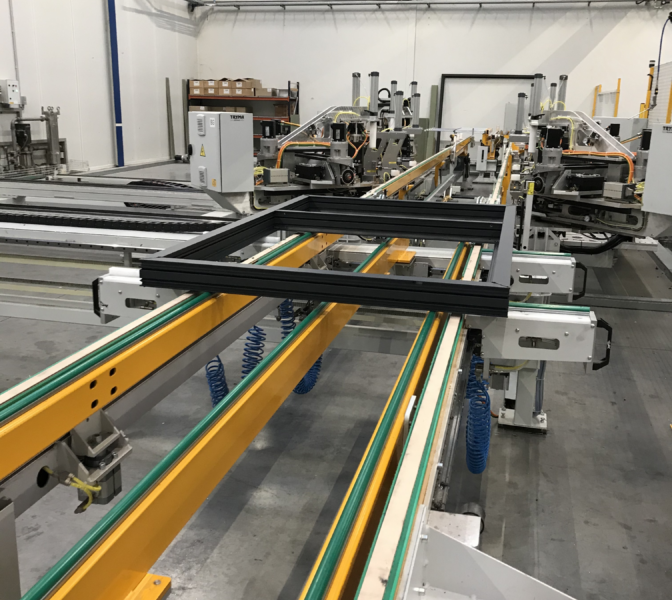
Once the frame has been assembled, it is transferred by an automatic infeed table to a unique Tryma solution: a CNC-controlled 4-head corner crimper. Each frame carries a specific barcode which, after scanning, ensures that the infeed table automatically adjusts to the correct dimensions. The frame is then transported into the press, where all four heads crimp the four corners simultaneously.
A key detail is that this process is profile-independent. Two tools are CNC-adjusted in height and depth, making it possible to crimp different profile types interchangeably with the same set of tools. This means the operator no longer needs to manually change crimping tools when switching profiles. The machine clamps everything firmly and offers a capacity of 6.5 m x 2.8 m, with an average cycle time of 80 seconds per frame. While the machine is automatically pressing, the operator can already prepare the next element – with no need for manual intervention.
Continuous Gasket Insertion
After the – likewise automatic – outfeed, the corners are cleaned and the frame is automatically transferred to the next machine. “The corner press is combined with a machine that inserts both the rebate and glazing gaskets in a continuous cycle. The frame passes automatically through the machine, which moves along its length. The machine is equipped with two heads, one for each type of gasket. To position the gaskets correctly, the sash needs to be rotated – and the machine takes care of that as well, with no manual handling required. Each groove is filled with the right amount of gasket in overlap, ensuring expansion and contraction are accommodated and eliminating any risk of sealing problems. Just like the 4-head press, the in-rolling machine knows exactly which frame is coming up, thanks to the scanned barcode.”
Automated Buffer System
The next step is the automated buffer system. “After gasket insertion, a transfer trolley collects the frame and places it in one of several buffer racks that stretch across the entire length of the hall. The sashes remain there until the trolley delivers them at the right time to the assembly station, where an operator installs the hardware and center gasket and fits the sash into its designated frame.”
The frames are also automatically transported by the transfer trolley, which knows exactly which sash belongs to which frame. To ensure the assembly takes place under ergonomic conditions, the work tables can be tilted. Several work tables are spread across the production hall, including one specifically designed for doors. In addition to the automated process described above, there is also a dedicated Tryma machine that inserts gaskets into glazing beads and façade profiles.
From Analysis to Optimization
So, beyond the delivery and installation of the machines, what is Tryma’s precise role in such projects? “First, we sit down with the customer to analyze the production process and identify all opportunities for optimization. Once every detail has been discussed, we create a layout that is always tailored to the customer’s profiles, gaskets, and processing needs. Based on this plan, we select the right machines, install them in the right place, and ensure the proper CNC integration.”
Companies interested in automated production can schedule a no-obligation consultation with a Tryma expert.


